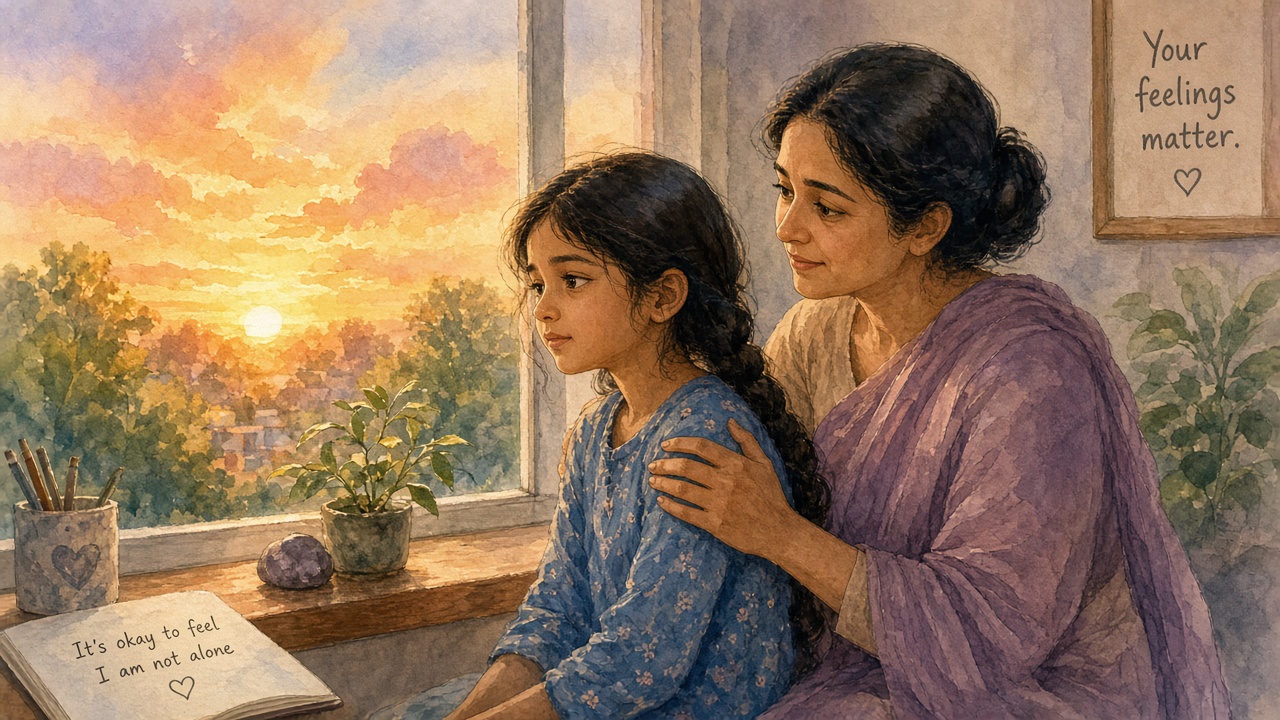
India has over 250 million children aged 5–18. UNICEF India's research on child and adolescent well-being shows that mental health challenges—anxiety, depression, self-harm, and the effects of bullying—are increasingly common but still widely under-recognised and under-treated.
This article helps parents notice the signs, support their child, and know when professional help is appropriate.
What emotional distress looks like in children
Children rarely say "I am depressed" or "I have anxiety." They show distress through behaviour, physical complaints, and changes in daily life. Watch for persistent changes lasting more than two weeks:
Younger children (5–10 years)
- Frequent stomach aches or headaches without a medical cause
- Refusing to go to school or clinging at drop-off
- Bedwetting after being dry for months
- Angry outbursts that are new or more intense than before
- Loss of interest in play or friends
- Trouble sleeping or frequent nightmares
Older children and adolescents (11–18 years)
- Withdrawal from family, friends, and activities they used to enjoy
- Drop in school performance
- Changes in eating or sleeping patterns
- Extreme irritability or mood swings beyond typical adolescence
- Talking about feeling worthless, hopeless, or wanting to disappear
- Self-harm (cutting, scratching, burning)
- Excessive phone or social-media use as a coping mechanism
Having supportive conversations
Many Indian families find it difficult to talk about feelings. Mental health is still stigmatised in parts of society. But conversations do not need to be formal or clinical. They can happen during a walk, a car ride, or while cooking together.
- Ask open questions: "How was your day, really?" instead of "Was school fine?"
- Listen without fixing: Resist the urge to immediately offer solutions. "That sounds really hard" is often more helpful than advice.
- Validate their feelings: "It makes sense that you feel angry about that." Validation is not agreement—it is acknowledgement.
- Share your own feelings appropriately: "I felt nervous too when I started a new job." This normalises emotion.
- Never mock or dismiss: "Don't be silly," "You have nothing to be sad about," and "You're being dramatic" shut conversations down.
Bullying: what parents need to know
Bullying includes physical aggression, verbal teasing, social exclusion, and cyberbullying. In India, academic pressure and social hierarchies can intensify bullying behaviour.
Signs your child may be bullied
- Reluctance to go to school or specific classes
- Unexplained injuries or damaged belongings
- Loss of friends or avoidance of social situations
- Decline in grades
- Reluctance to use their phone or computer (cyberbullying)
What to do
- Believe them. Do not assume they are exaggerating.
- Discuss what happened calmly. Ask what they want to do about it.
- Contact the school. Document incidents with dates and details.
- Teach assertiveness, not aggression: "Stop. I don't like that."
- Monitor cyberbullying. Keep communication open about what happens online.
- If the school is unresponsive, escalate in writing.
Academic pressure and mental health
India's competitive exam culture puts immense pressure on children, sometimes starting in primary school. Research links excessive academic pressure with anxiety, depression, sleep disorders, and in severe cases, suicidal ideation.
- Watch for signs of burnout: chronic fatigue, loss of interest in everything, and expressions of hopelessness about the future.
- A child's worth is not their mark sheet. Say this out loud, often.
- Ensure they have time for play, rest, and friendships—not just tuitions and homework.
- If coaching classes cause more distress than benefit, reconsider them.
Respecting privacy while staying informed
As children grow, they need privacy. Reading their diary or checking every message can damage trust. The balance is:
- Stay connected through daily conversations, not surveillance.
- Know their friends, teachers, and general online activity.
- Agree on boundaries together: which apps are appropriate, screen-free times, and when a parent will check in.
- If you are genuinely worried about safety (self-harm, exploitation, substance use), direct intervention is necessary—but explain why.
When to seek professional help
- Symptoms persist for more than two weeks and affect daily life.
- The child talks about wanting to die or not wanting to exist.
- Self-harm is discovered.
- There is a significant change in personality or functioning.
- You feel out of your depth as a parent.
Professional help does not mean your child is "broken." It means they need support that is beyond what a parent can provide alone. A child psychologist or psychiatrist can assess, diagnose, and treat with evidence-based methods.
Sources
- UNICEF India. The state of children's mental health.
- UNICEF. On my mind: promoting, protecting and caring for children's mental health. 2021.
- Lancet Commission on Adolescent Health. Our future: a Lancet commission on adolescent health and wellbeing. 2016.