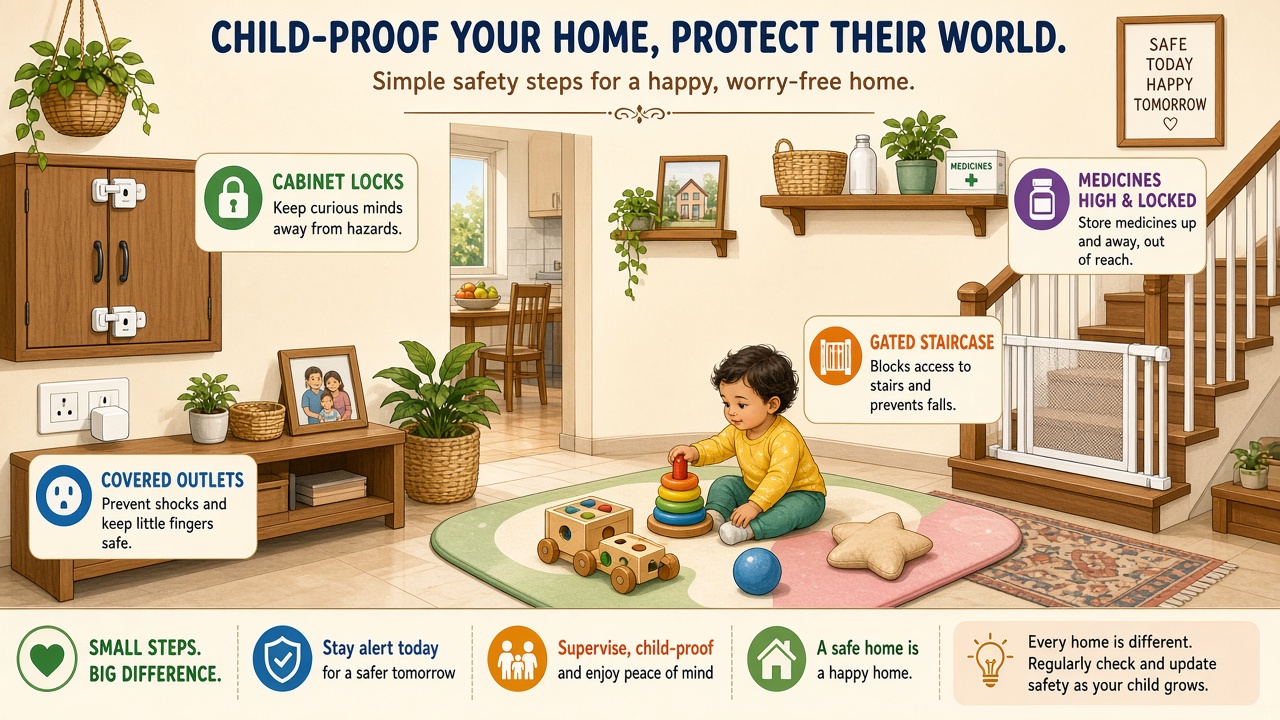
Unintentional injuries are among the leading causes of death and hospitalisation for children under five in India. Most of these injuries happen at home and most are preventable. This article provides a room-by-room safety checklist for Indian homes, covering the five most common hazards: choking, burns, falls, poisoning, and drowning.
Kitchen
The kitchen is the most dangerous room in the house for a child under three.
- Hot liquids: Keep chai, dal, and cooking pots on the back burners with handles turned inward. A toddler can pull a pot of boiling water off the stove. Never hold a child while pouring or cooking.
- Gas stove: Use stove-knob covers or turn the gas off at the cylinder when not in use. A child can turn the knob.
- Sharp objects: Knives, scissors, peelers, and graters should be stored in closed drawers with child-safety latches.
- Cleaning products: Harpic, phenyl, dishwashing liquid, and pest sprays must be kept in a locked cabinet, never on the floor. Children are attracted to bright-coloured bottles.
- Choking hazards: Whole nuts, popcorn, whole grapes, raw carrot sticks, and hard candy should not be within reach.
Bathroom and washroom
- Water: Never leave a baby or toddler alone in a bathtub, even for a moment. A child can drown in as little as 2 inches of water.
- Buckets and tubs: In Indian homes, large buckets and water drums are common. Empty them after use or keep the bathroom door locked. A toddler can fall headfirst into a half-filled bucket.
- Hot water: Test the water temperature before bathing a child. Geyser water can scald in seconds.
- Medicines and toiletries: All medicines, shampoos, and cosmetics should be stored high and locked. Paracetamol syrup, iron supplements, and cough syrups are common causes of accidental poisoning in children.
- Wet floors: Use non-slip mats. A running toddler can slip and hit their head.
Living room and bedroom
- Electrical outlets: Cover all unused outlets with socket covers. Toddlers push fingers and metal objects into sockets.
- Furniture: Anchor bookshelves, TV stands, and almirahs to the wall. A climbing toddler can topple heavy furniture.
- Cords and strings: Keep curtain cords, charging cables, and ironing-board cords out of reach. Strangulation risk is real.
- Small objects: Coins, buttons, batteries (especially button batteries), beads, and pen caps are choking hazards. Keep them off low tables.
- Beds: Use bed rails or place the mattress on the floor for young children. Falls from adult beds are the most common injury in infants.
- Fans: Ensure ceiling fans are securely fastened. Keep table fans where a child cannot reach the blades.
Balcony and terrace
- Railing gaps: A child can slip through wide railing gaps. If the gap is more than 4 inches, install a mesh or barrier.
- Climbable objects: Do not place chairs, flower pots, or boxes near balcony railings. Children climb.
- Access: Keep the balcony door locked when the child is unsupervised.
- Terrace: Terraces without parapet walls or with low walls are extremely dangerous. Children should never be on a terrace unsupervised.
Specific hazards
Choking
Children under 4 are at the highest risk. Common choking items: whole nuts, grapes, popcorn, coins, button batteries, small toy parts, and hard candy.
Prevention:
- Cut food into small, age-appropriate pieces.
- Supervise all meals.
- Buy toys appropriate for the child's age (check the label).
- Keep batteries, coins, and small parts in closed containers.
If a child is choking: Learn infant and child choking first aid from a certified course. For infants: 5 back blows and 5 chest thrusts. For children over 1: abdominal thrusts (Heimlich manoeuvre). Call emergency services immediately.
Burns and scalds
Hot chai, cooking oil, and iron box burns are the most common in Indian homes.
Immediate first aid: Run cool (not ice-cold) water over the burn for at least 20 minutes. Do not apply toothpaste, ghee, ice, or raw egg—these are harmful myths. Cover with a clean cloth and seek medical attention for burns larger than the child's palm.
Falls
Falls from beds, changing tables, stairs, and balconies. Use stair gates, bed rails, and never leave a baby on an elevated surface unattended.
Poisoning
Medicines, cleaning products, pesticides, and kerosene are the most common causes.
If you suspect poisoning: Do not make the child vomit (this can cause further harm with certain substances). Take the child and the container to the nearest hospital immediately. Call your local poison helpline if available.
Drowning
Bathtubs, buckets, open wells, and water tanks. Empty all containers after use. Supervise water play at all times. Teach swimming when the child is old enough (usually 4+). In rural areas, cover open wells and water tanks with secure lids.
Share this checklist with your nanny
If a nanny cares for your child at home, walk them through every point in this checklist. Show them where the first-aid kit is, what numbers to call in an emergency, and which rooms or areas are off-limits. A written emergency plan on the fridge or near the door saves critical seconds.
Sources
- WHO. World report on child injury prevention.
- Indian Academy of Pediatrics. Injury prevention guidelines.
- Safe Kids Worldwide. Home safety checklist.