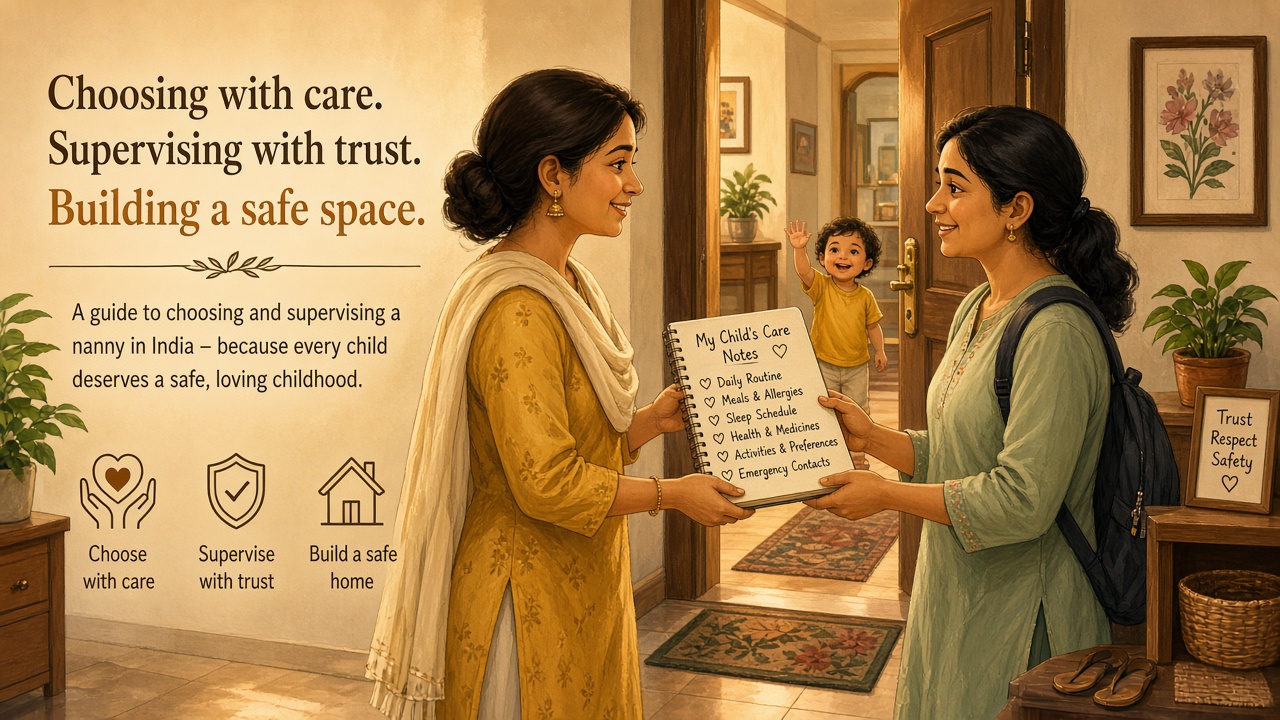
Hiring someone to care for your child in your absence is one of the most consequential decisions a parent makes. In India, the nanny market is largely informal: most caregivers are found through word of mouth, domestic-help agencies, or increasingly through platforms like Zipnny. The quality of screening varies enormously.
This guide covers practical steps for choosing, onboarding, supervising, and communicating with a nanny, grounded in child-safeguarding and responsive-caregiving principles recommended by the WHO.
Before you hire: checking identity and references
No screening process is perfect, but basic checks reduce risk significantly.
- Verify identity: Ask for an Aadhaar card or other government-issued ID. Record the details.
- Check references: Speak to at least two previous employers. Ask specific questions: "How did she handle an emergency?" "Was she ever left alone with the child?" "Why did the arrangement end?"
- Police verification: Many state police departments offer background-verification services for domestic workers. It takes time but is worth doing. Platforms like Zipnny run this before a nanny is approved.
- Health check: A basic health certificate from a government clinic confirms the caregiver is free from communicable diseases. This protects the child and the nanny.
Important: No background check guarantees safety. Verification reduces risk, but ongoing supervision, open communication, and trusting your instincts remain essential.
The trial period: before you commit
Book a single session or a trial week before locking a long-term arrangement. During the trial:
- Observe how the nanny interacts with your child. Is she warm? Patient? Does she talk to the child?
- Watch how she handles crying, mess, and the child saying "no."
- Leave for a short period (30–60 minutes) and return earlier than expected.
- Ask your child (if they can communicate) how they felt. Young children may not have words, but they show comfort or distress through behaviour.
Setting clear expectations
Misunderstandings happen when expectations are not written down. Before the first full day, agree on:
Daily duties
- What the nanny is responsible for: childcare, meals, tidying the child's area, bathing the child, homework help.
- What the nanny is not responsible for: cooking for the family, cleaning the house, laundry. Mixing roles leads to burnout and neglect of the child.
Safety rules
- Which rooms are off-limits (kitchen, balcony, terrace).
- Who is allowed to enter the house (no visitors unless you approve).
- Screen-time rules: how much, which shows, and when.
- Whether the nanny may take the child outside, and where.
- Car or auto rules: never leave the child alone in a vehicle.
Emergency information
- Your phone number and one backup adult.
- Paediatrician's number.
- Nearest hospital address and route.
- What to do if the child chokes, has a seizure, or is injured.
- Allergies and medicines: written on paper, on the fridge or near the first-aid kit.
Feeding and sleep instructions
Written notes prevent guesswork:
- What the child may eat and what is off-limits (allergies, restrictions).
- Meal and snack times.
- Nap time and how to settle the child (rocking, patting, a specific toy).
- Safe sleep position for infants: on the back, on a firm surface, no pillows or loose bedding.
Supervision: age-appropriate and ongoing
Supervision does not mean suspicion. It means staying involved:
- Drop in unexpectedly occasionally. Not to catch anyone, but to see how normal days go.
- Ask your child (at any age) about their day. Listen to how they describe time with the nanny.
- Notice changes in behaviour: new fears, reluctance to be left, regression (bedwetting, clinginess), or unexplained marks.
- Talk to the nanny daily. "How was today? What did he eat? Did he sleep well? Anything I should know?" Consistent communication builds trust and reveals small issues before they become large ones.
- Home cameras: If you use them, tell the nanny. Informed monitoring is ethical; hidden surveillance damages trust. Some families place a camera in the living room or child's room and discuss this openly during hiring.
Communication: respectful and direct
A nanny who is treated with respect is more likely to stay, to speak up about problems, and to care genuinely for your child.
- Use her name. Not "didi" or "bai" unless she prefers it.
- Pay on time, every time. Agree on the salary, overtime, holidays, and sick leave in writing.
- Give feedback directly and kindly: "I'd prefer you give him water instead of juice in the afternoon."
- Listen when she tells you something about your child. She sees hours you don't.
- If something is wrong, address it promptly. If trust is broken, end the arrangement. Do not compromise your child's safety out of inconvenience.
Teaching your child about body safety
Age-appropriate body-safety education is a layer of protection:
- Teach the correct names for body parts from an early age.
- Explain that private parts (covered by underwear) are private. No one should touch, look at, or photograph them.
- Teach the "no-go-tell" rule: say no, get away, tell a trusted adult.
- Reassure your child that they will never be in trouble for telling you something uncomfortable.
- These conversations should be calm, matter-of-fact, and repeated periodically—not as a single scary talk.
When to end the arrangement
- Your child shows persistent fear, distress, or behavioural changes after being with the nanny.
- Unexplained injuries appear.
- The nanny ignores safety instructions repeatedly.
- You discover dishonesty about identity, references, or events during the day.
- Your instinct tells you something is not right. Trust it.
What platforms like Zipnny do—and what they don't
Platforms that verify nannies before listing them add a layer of checking that informal hiring cannot match. Zipnny runs police verification, reference checks, and a training programme that covers first aid, child safety, and responsive caregiving.
But no platform can guarantee that a person will behave perfectly in your home every day. The verification is a gate—not a guarantee. Your ongoing supervision, communication, and involvement are what keep your child safe after the nanny walks through the door.
Sources
- WHO. Improving early childhood development: WHO guideline. 2020. (Responsive caregiving component.)
- WHO. INSPIRE: seven strategies for ending violence against children. 2016.
- UNICEF. Child safeguarding policy and toolkit.