"Is my child eating enough?" is the question Indian paediatricians hear most often. The worry is understandable: India's National Family Health Survey (NFHS-5, 2019–21) found that 35.5% of children under five are stunted and 32.1% are underweight. Iron-deficiency anaemia affects 67.1% of children aged 6–59 months.
But weight alone does not tell the whole story. This article explains how to assess your child's nutrition using evidence, not guesswork.
Growth charts: how to read them
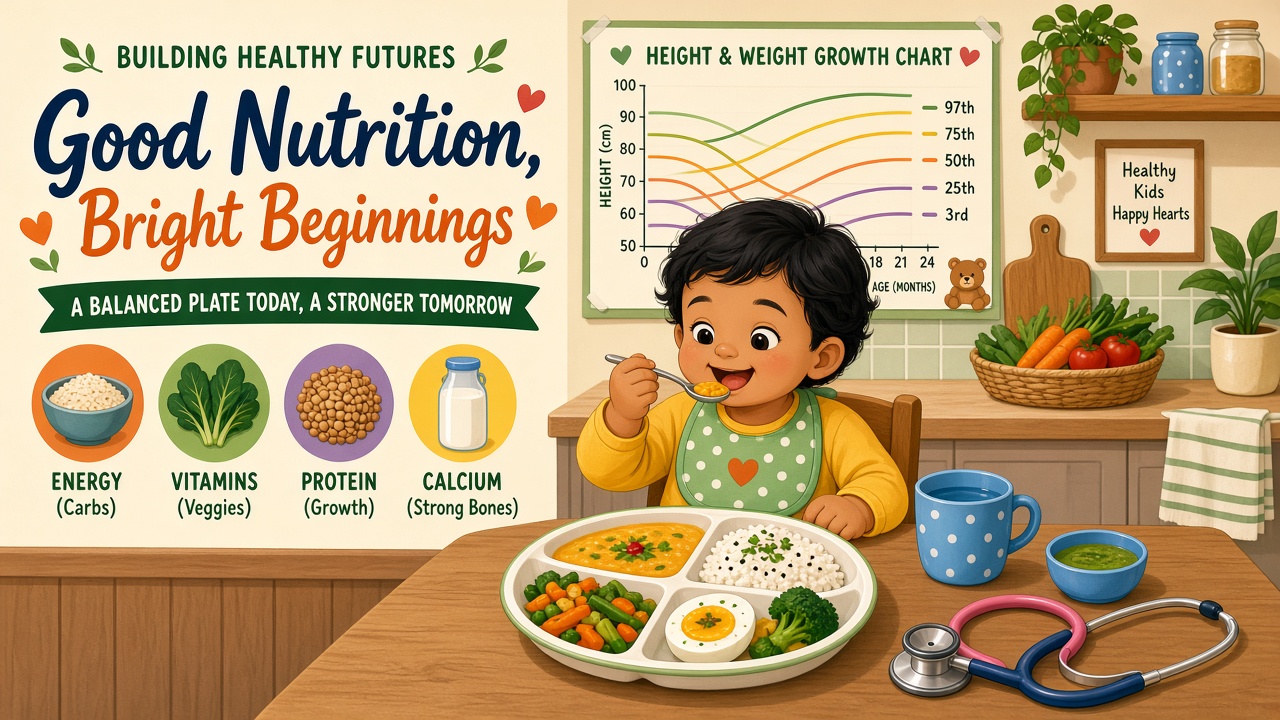
The WHO Child Growth Standards track a child's weight-for-age, height-for-age, and weight-for-height on percentile curves. Your paediatrician plots your child's measurements on these charts at each visit.
- Percentiles are not grades. A child on the 25th percentile is not "failing." It means 25% of healthy children of the same age and sex weigh the same or less.
- The trend matters more than a single point. A child consistently growing along the 15th percentile is healthy. A child falling from the 50th to the 5th percentile over three months needs assessment.
- Height-for-age matters. Chronic undernutrition (stunting) shows in low height-for-age, even if the child's weight looks acceptable.
- Weight-for-height shows acute nutrition status. A child can be short for their age but the right weight for that height—or vice versa.
Ask your paediatrician to show you the chart and explain where your child sits. A single measurement without context is not useful.
Iron deficiency: the most common nutritional problem
Iron deficiency is widespread in Indian children because of diet patterns (low intake of animal-source foods), poor bioavailability of iron from plant foods, and frequent infections. It matters because iron is essential for brain development, immunity, and energy.
Signs that may suggest iron deficiency:
- Pale skin, especially palms and inner eyelids
- Unusual tiredness and irritability
- Poor appetite
- Frequent infections
- Delayed milestones in infants
What to eat for iron:
- Egg, chicken, fish, and liver (highest bioavailability)
- Cooked lentils, beans, and chickpeas
- Green leafy vegetables: spinach (palak), fenugreek (methi), amaranth
- Ragi, bajra, jowar
- Iron-fortified cereals (check the label for actual iron content)
Pair with vitamin C (tomato, lemon, orange, amla) and avoid tea or coffee during or right after meals. If you suspect anaemia, ask your paediatrician for a blood test—do not start iron supplements on your own.
Dietary diversity: the real measure of a good diet
UNICEF India uses "minimum dietary diversity" as a key indicator. A child aged 6–23 months should eat from at least five of these eight food groups daily:
- Breast milk
- Grains, roots, tubers (rice, roti, potato)
- Legumes and nuts (dal, rajma, chana, groundnut)
- Dairy (milk, curd, paneer)
- Flesh foods (egg, chicken, fish, meat)
- Eggs (counted separately)
- Vitamin-A-rich fruits and vegetables (mango, papaya, carrot, pumpkin, sweet potato, dark leafy greens)
- Other fruits and vegetables (banana, apple, cucumber, beans)
In practice, many Indian children eat dal-rice but miss out on eggs, fruits, and vegetables. A diverse plate every day is more important than expensive "superfoods."
Protein: how much and from where
Indian diets can be low in protein, especially in vegetarian families that rely heavily on cereals. Protein needs per kg of body weight are highest in infancy and decline through childhood.
- Good vegetarian sources: dal, curd, paneer, soy chunks, sprouted moong, rajma, chana.
- Non-vegetarian sources: egg, chicken, fish.
- Combining cereals and pulses (khichdi, dal-rice, roti-chana) improves protein quality.
The Indian Council of Medical Research (ICMR) recommends that protein should account for about 8–15% of a child's daily energy intake. A child who eats dal and curd twice a day is unlikely to be protein-deficient. A child who eats mostly biscuits and chips might be.
Common myths
- "My child is thin, so they are malnourished." Not necessarily. Some children are naturally lean. Consistent growth along their own curve is the key.
- "Health drinks make children taller." No commercial drink replaces a balanced diet. The marketing is not evidence.
- "Ghee makes children healthy." Ghee provides calories and some vitamins, but is not a substitute for protein, iron, or vegetables.
- "If they don't eat, give them supplements." Supplements should be prescribed by a doctor after assessment, not given as a substitute for food.
When to see a doctor
- The child is consistently losing weight or falling off their growth curve.
- They look pale and tired most of the time.
- They refuse almost all food for more than two weeks.
- Developmental milestones are delayed.
- You notice swelling (oedema) in the feet or face.
Sources
- UNICEF India. Nutrition research and analysis: children and women in India.
- International Institute for Population Sciences (IIPS). National Family Health Survey (NFHS-5), 2019–21. Ministry of Health and Family Welfare, Government of India.
- WHO. Child growth standards. Geneva: World Health Organization.
- ICMR-NIN. Dietary guidelines for Indians. Indian Council of Medical Research – National Institute of Nutrition; 2024.