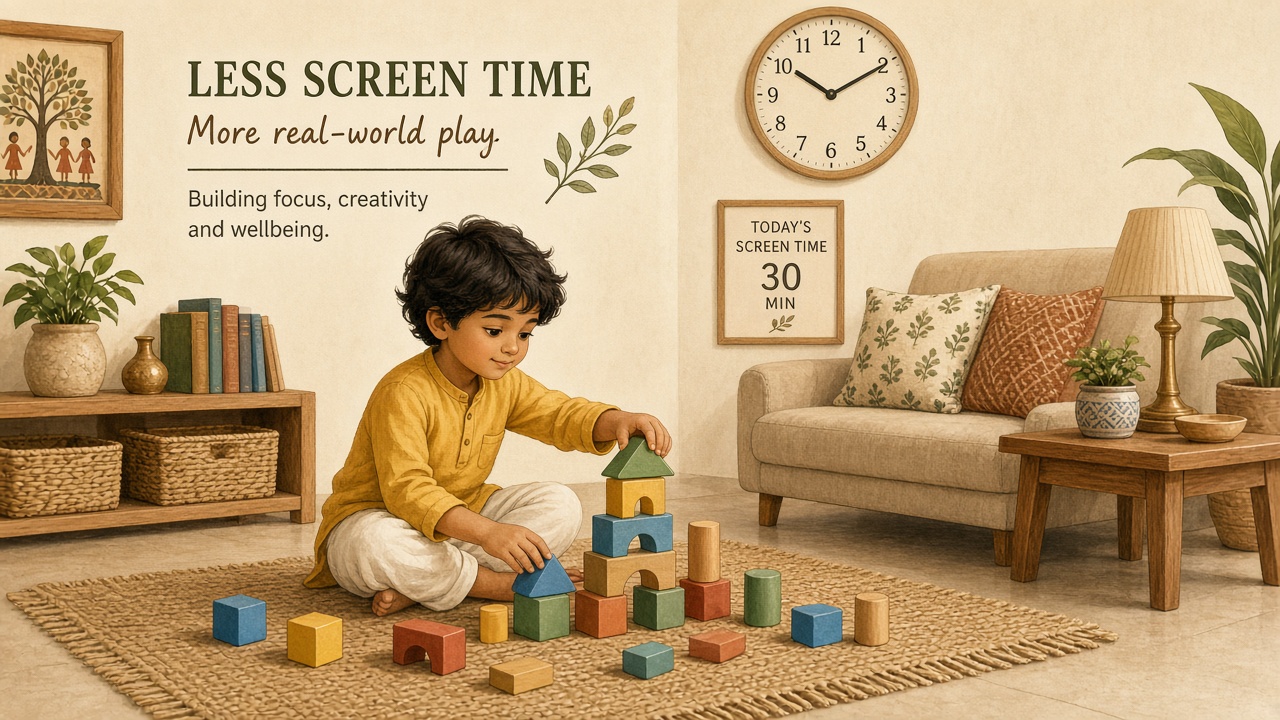
Screens are everywhere in Indian homes—televisions, smartphones, tablets, laptops. The question is no longer whether children will see screens, but how much, what kind, and at what age. This article summarises what the evidence says, drawn mainly from the WHO's 2019 guidelines on physical activity, sedentary behaviour, and sleep for children under five.
What the WHO recommends by age
Under 12 months: No screen time at all. When the baby is sedentary, caregivers should engage them with storytelling, reading, and interactive play.
12–24 months: No sedentary screen time is recommended. If parents choose to introduce screens, the WHO suggests keeping it to no more than a few minutes at a time, never during meals, and always with a caregiver watching and talking about what is on the screen.
2–4 years: No more than one hour per day. Less is better. The time should not be passive viewing—choose content that involves interaction, songs, or stories. Avoid screens in the hour before bed.
5–12 years: The WHO does not set a strict cap for this age, but paediatric bodies such as the Indian Academy of Pediatrics (IAP) recommend limiting recreational screen time to 1–2 hours per day and prioritising physical activity and sleep.
Video calls are different from passive viewing
In Indian families, video calls with grandparents, relatives abroad, or a parent who is travelling are common. These are interactive, social, and involve real-time communication. The evidence treats them differently from passive watching of cartoons or videos.
A video call where a grandparent reads a story or plays peek-a-boo is closer to face-to-face interaction than to passive TV. This distinction matters, especially for families with members in different cities or countries.
Why screens during meals are a problem
In many Indian households, the TV or phone is used to distract a child during feeding. Research associates this with:
- Children losing awareness of hunger and fullness cues
- Increased calorie intake in some studies, decreased intake in others—both are problematic
- Mealtime becoming dependent on screens, making it harder to eat without one
- Reduced family conversation during meals
Turning off screens during meals is one of the simplest and most effective changes a family can make.
Screens and sleep
Blue light from screens suppresses melatonin, the hormone that helps regulate sleep. The WHO guidelines link excessive screen time with reduced sleep duration and quality in young children. The effect is stronger when screens are used close to bedtime.
- No screens in the bedroom at night.
- Stop all screens at least 30–60 minutes before the child's bedtime.
- Replace the bedtime screen with a book, a story, or a conversation.
Caregiver phone habits matter too
A parent or nanny who is constantly on their phone is less responsive to a child's cues. Studies show that caregiver phone distraction during play and meals reduces the quality of interaction and is associated with more behavioural difficulties in children.
This is not about guilt—it is about awareness. Putting the phone down during playtime and meals makes a measurable difference.
Realistic alternatives for busy parents
Banning screens entirely is unrealistic in most Indian homes. The goal is to reduce, not eliminate. Here are alternatives that work in real life:
- A box of safe kitchen items: steel bowls, wooden spoons, plastic containers. Toddlers will play with these for 20 minutes.
- Water play: one bowl of water and some cups in the bathroom or kitchen.
- Crayons and paper. Scribbling is developmental play for toddlers.
- A picture book. Even if the child "reads" it alone, they are building pre-literacy skills.
- Helping in the kitchen: washing vegetables, stirring batter, arranging plates. Children love to contribute.
- Outdoor time: even 20 minutes in a park or balcony with physical play is better than 20 minutes of screen time.
What the evidence does not yet settle
Not all screen-time questions have clear answers. The research is still developing on:
- Whether educational apps for 3–5-year-olds provide meaningful cognitive benefits
- The long-term effects of short-form video content (reels, shorts) on attention span
- Optimal screen limits for children aged 6–12
Where evidence is limited, the precautionary approach is to prioritise physical activity, sleep, and human interaction—all of which have strong evidence behind them.
A practical family screen plan
- Decide which hours are screen-free (meals, bedtime, first hour of the morning).
- Choose what the child watches—not random autoplay.
- Watch together when possible and talk about what is on screen.
- Keep a few non-screen activities ready for moments when you need the child occupied.
- Model the behaviour: put your own phone down during family time.
Sources
- WHO. Guidelines on physical activity, sedentary behaviour and sleep for children under 5 years of age. Geneva: World Health Organization; 2019.
- Indian Academy of Pediatrics. Screen time recommendations.
- Radesky, J.S., et al. "Patterns of mobile device use by caregivers and children during meals." Pediatrics, 2014.