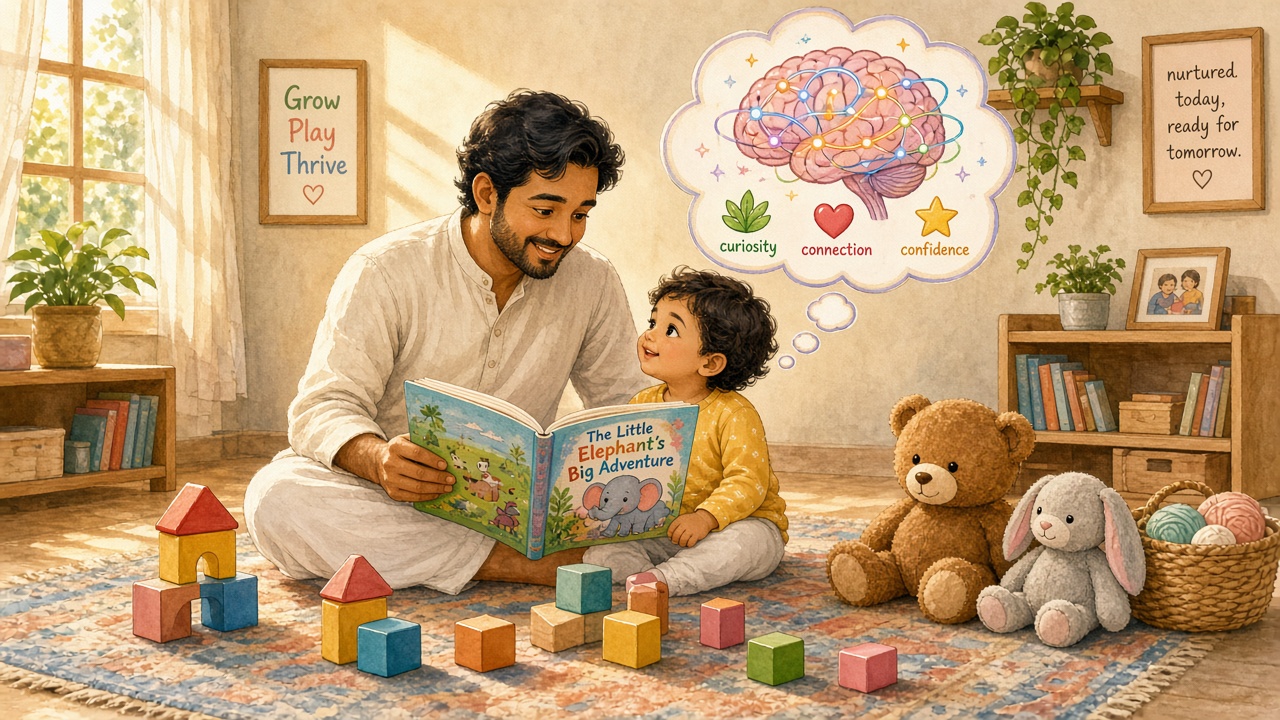
A child's brain forms more than one million new neural connections every second in the first few years of life. The quality of those connections depends not on expensive toys or flash-card drills, but on the everyday interactions a child has with the people around them.
The WHO's Improving early childhood development guideline (2020) identifies responsive caregiving—talking, playing, reading, singing, and responding to a child's cues—as one of the most important interventions for healthy brain development.
What is responsive caregiving?
Responsive caregiving means noticing what a child is feeling or trying to communicate, and responding in a way that is warm, consistent, and appropriate. It is not about perfection. It is about being present.
- A baby cries → you pick them up and comfort them. This teaches the brain: "I am safe. The world responds to me."
- A toddler points at a dog → you say, "Yes, that's a dog! A big brown dog." This builds language, shared attention, and categorisation.
- A 4-year-old builds a tower and it falls → you say, "Oh no! Want to try again?" This builds resilience, problem-solving, and emotional regulation.
Talking: the most powerful tool you already have
Research consistently shows that the quantity and quality of language a child hears in the first five years is one of the strongest predictors of vocabulary, reading ability, and school success.
Practical ways to talk more:
- Narrate what you are doing: "I'm cutting the cucumber. See? It's green inside."
- Name what the child sees: "That's an auto. It's yellow."
- Expand their words: if the child says "milk," respond, "You want milk? Let me get your milk."
- Ask open questions: "What do you think will happen?" instead of "Is this a ball?"
- Sing songs, recite rhymes, tell stories from your own childhood.
Use your home language. Speaking to your child in the language you are most comfortable with—Hindi, Tamil, Bengali, Marathi, or any other—gives them a richer, more natural input than speaking in a language you are less fluent in. Bilingualism and multilingualism are advantages, not problems.
Play: how children learn
Play is not a distraction from learning. It is how children learn. The WHO guideline specifically recommends interactive floor play from birth.
By age:
- 0–6 months: Tummy time, looking at faces, tracking objects, gentle rattles, singing.
- 6–12 months: Peek-a-boo, stacking and knocking down, banging pots, filling and emptying containers, reading simple board books.
- 1–3 years: Pretend play (cooking, shopping), building blocks, scribbling with crayons, water play, sand play, naming body parts.
- 3–5 years: Drawing, storytelling, puzzles, outdoor running and climbing, role-play, counting during daily activities.
Expensive toys are not necessary. A cardboard box, a set of steel bowls, a ball, a few crayons, and a stack of picture books provide more developmental value than most electronic toys. The key ingredient is a caregiver who plays with the child, not beside them.
Responding to cues: the "serve and return" pattern
Harvard's Center on the Developing Child describes the core interaction as "serve and return": the child babbles, points, or cries (serves), and the adult responds with eye contact, words, or a hug (returns). When this back-and-forth happens thousands of times, it physically builds the architecture of the brain.
When a child's signals are consistently ignored—because the caregiver is distracted, absent, or overwhelmed—the brain's stress-response system stays activated, which can affect learning, memory, and emotional regulation.
This does not mean you must respond perfectly every time. It means that most of the time, most days, someone is paying attention.
What caregivers and nannies can do
If your child spends part of the day with a nanny or other caregiver, share these ideas with them:
- Talk to the child during meals, diaper changes, and walks—not just during "activity time."
- Follow the child's interest: if they are fascinated by an ant, talk about the ant.
- Read aloud even to babies. The rhythm and tone matter more than comprehension at this stage.
- Limit screen use. A phone playing a cartoon is not a substitute for human interaction.
- Let the child try things, get messy, and fail safely.
What is not necessary
- Flash-card programmes for babies
- Expensive "brain development" classes for toddlers
- Electronic learning tablets for children under 3
- Pressure to read or write before school age
The evidence is clear: warm, responsive, language-rich interactions with a caring adult are the most powerful brain-building activity there is. Everything else is optional.
Sources
- WHO, UNICEF, World Bank Group. Improving early childhood development: WHO guideline. Geneva: World Health Organization; 2020.
- Center on the Developing Child, Harvard University. Serve and return.
- Shonkoff, J.P., et al. "The lifelong effects of early childhood adversity and toxic stress." Pediatrics, 2012.