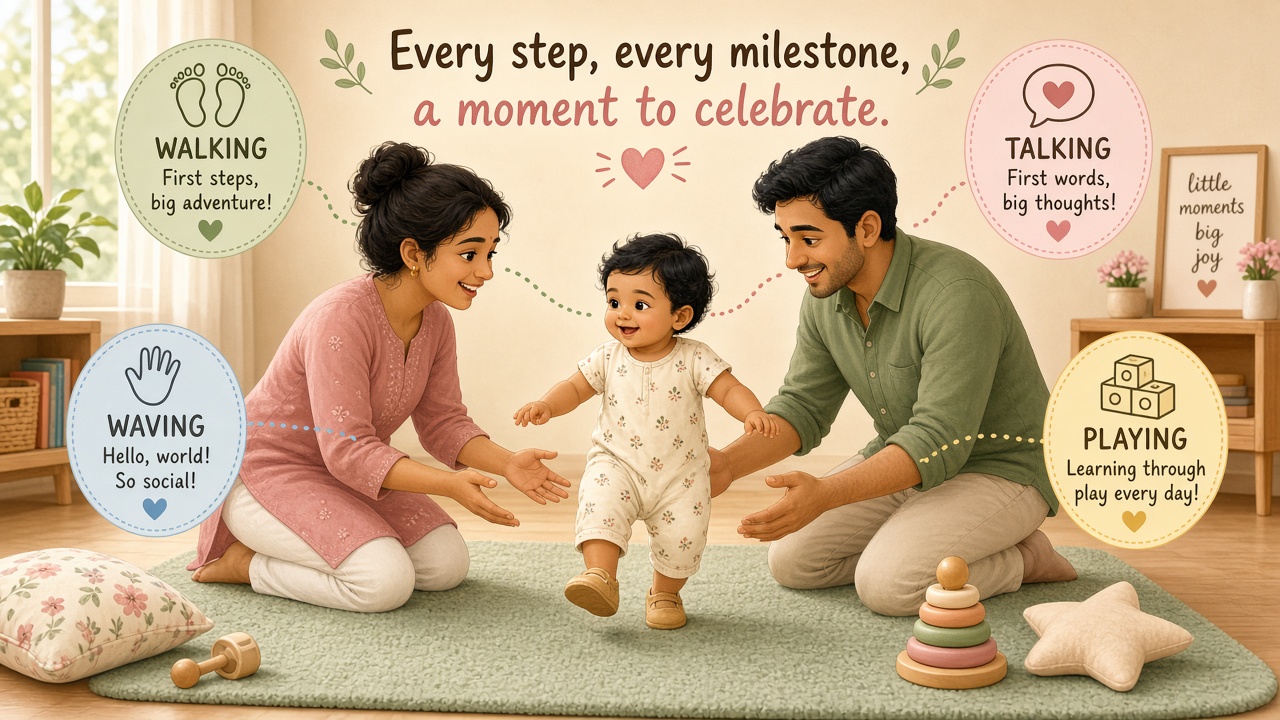
Developmental milestones are skills most children reach by a certain age—sitting, walking, saying first words, pretend play. They are guides, not exams. Every child develops at their own pace, influenced by genetics, nutrition, health, stimulation, and opportunity.
What matters is the overall pattern: is the child progressing? Are new skills appearing? Is there any loss of skills they had before? This article covers the key milestones by age, based on guidance from UNICEF India and the WHO.
0–3 months
- Movement: Lifts head briefly during tummy time. Brings hands to mouth. Moves arms and legs.
- Senses: Follows objects with eyes. Turns towards sounds. Recognises familiar faces.
- Communication: Coos and makes gurgling sounds. Cries to express needs.
- Social: Begins to smile at people. Calms down when picked up.
4–6 months
- Movement: Rolls over (front to back, then back to front). Holds head steady. Begins to sit with support. Reaches for toys.
- Communication: Babbles with vowel sounds ("ah," "eh," "oh"). Laughs. Responds to their name.
- Social: Recognises familiar people. Shows interest in mirror reflections. Enjoys playing with people.
7–9 months
- Movement: Sits without support. Crawls or scoots. Pulls to stand. Transfers objects between hands.
- Communication: Babbles consonant-vowel combinations ("ba-ba," "da-da"). Understands "no." Points at things.
- Social: Stranger anxiety appears. Plays peek-a-boo. Looks for hidden toys (object permanence).
10–12 months
- Movement: Stands holding furniture. Cruises along furniture. May take first steps. Uses pincer grasp (thumb and forefinger) to pick up small objects.
- Communication: Says 1–3 words ("mama," "dada," "bye"). Follows simple instructions like "give me the ball."
- Social: Waves bye-bye. Plays simple interactive games. Shows preferences for certain people and toys.
13–18 months
- Movement: Walks independently. Climbs onto low furniture. Stacks 2–3 blocks. Scribbles with a crayon.
- Communication: Uses 5–20 words. Points to show things. Understands more words than they say.
- Social: Copies adults (sweeping, talking on phone). Shows affection. Has tantrums when frustrated.
19–24 months
- Movement: Runs. Kicks a ball. Walks up steps with help. Stacks 4–6 blocks.
- Communication: Uses 50+ words. Begins to combine two words ("more milk," "big dog"). Follows two-step instructions.
- Social: Plays alongside other children (parallel play). Begins pretend play (feeding a doll). Says "no" frequently (this is healthy).
2–3 years
- Movement: Jumps with both feet. Pedals a tricycle. Draws circles and lines. Uses a spoon and fork.
- Communication: Uses 200–1,000 words. Speaks in sentences of 3–4 words. Asks "why?" repeatedly. Strangers can understand most of their speech.
- Social: Takes turns (with reminders). Names emotions ("I'm sad"). Plays make-believe. Separates from parents more easily.
3–5 years
- Movement: Hops on one foot. Catches a bounced ball. Draws a person with 2–4 body parts. Uses scissors. Dresses and undresses with help.
- Communication: Tells stories. Understands time concepts (yesterday, tomorrow). Knows some letters, numbers, and colours. Speaks clearly enough for strangers to understand.
- Social: Plays cooperatively with other children. Follows rules in simple games. Shows empathy ("Are you okay?"). Has a best friend.
When to ask for help
Milestones have a wide range of "normal." However, discuss with your paediatrician if:
- The child loses a skill they had before (for example, they were saying words and stopped).
- No babbling by 12 months or no words by 18 months.
- No walking by 18 months.
- No two-word phrases by 24 months.
- The child does not respond to their name by 12 months.
- No eye contact or social smiling.
- Extremely rigid routines with intense distress at minor changes.
- You have a gut feeling something is not right. Parental intuition is a valid reason to seek assessment.
Early identification and early intervention make a significant difference. Waiting to "see if they grow out of it" can delay support that would have helped.
A note on comparisons
Comparing your child to a cousin, a neighbour's child, or a development chart on social media is natural but can be misleading. Development is not a race. A child who walks at 14 months is not "behind" a child who walked at 10 months. What matters is the overall trajectory, not a single milestone in isolation.
Sources
- UNICEF India. Early childhood development: nurturing care for every child.
- WHO. Improving early childhood development: WHO guideline. 2020.
- CDC (US Centers for Disease Control and Prevention). Developmental milestones. Updated 2022.